
Insights
February 6, 2026
2025 M&A Year in Review
In Insights
In this report, Coldstream examines the historical quantitative and qualitative drivers of M&A, the forces that accelerated activity in 2025, and the emerging themes likely to influence dealmaking in the year ahead.
Renewed Momentum but Increased Selectivity
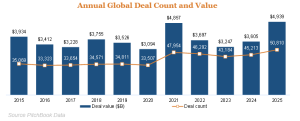
After a two-year reset, global M&A found its footing in 2025 with renewed momentum, disciplined underwriting, and a selective return of risk appetite.
KEY TAKEAWAYS
- M&A activity rebounded meaningfully in 2025, driven by improved financing conditions, stabilizing macro indicators, and narrowing bid-ask spreads.
- Quality and strategic fit outweighed growth, with buyers concentrating on assets with durable cash flows, defensible positions, and clear value-creation levers.
- A surge in megadeals drove much of the year’s deal value growth, with 617 transactions over $1 billion accounting for approximately 1.5% of total deal volume but $2.6 trillion, or 56.6%, of total M&A value, as both megadeal count and size increased significantly.
- Creative deal structures became mainstream, reflecting lingering valuation gaps and a continued focus on downside protection.
While activity strengthened broadly, the recovery was defined more by selectivity than exuberance. Buyers prioritized high-quality assets with durable cash flows, defensible market positions, and clear strategic fit, leading to continued dispersion in valuation outcomes. Large, well-capitalized strategics and scaled private equity platforms dominated competitive processes, while sponsors increasingly relied on creative structures such as minority investments, continuation vehicles, and structured equity to bridge residual valuation gaps.
Private equity re-emerged as a central driver of deal activity, supported by record levels of dry powder and growing pressure to deploy capital and generate realizations. Strategic buyers, particularly in technology-enabled services, industrials, and healthcare-adjacent sectors, pursued acquisitions to accelerate growth, enhance capabilities, and reposition portfolios for long-term resilience.
Drivers Behind the Market Rebound
The rebound in global M&A during 2025 was driven by a combination of improving quantitative fundamentals and reinforcing qualitative motivations. Together, these forces reduced execution risk, narrowed valuation gaps, and restored confidence across buyer groups.
QUANTITATIVE DRIVERS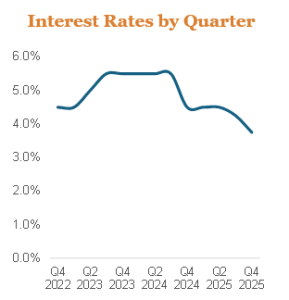
1.Financing Conditions Improved, Though Remained Selective: Debt markets reopened meaningfully in 2025 as base rates stabilized, and credit spreads tightened from 2023 peaks. Leveraged loan and high-yield issuance recovered, supporting transactions with more conservative leverage.
2.Equity Market Strength Reinforced Valuation Confidence: Rising indices and lower volatility boosted buyer confidence and supported equity-financed deals, anchoring valuations and facilitating bid-ask convergence.
3.Capital Availability and Deployment Pressures: Private equity entered 2025 with elevated levels of undeployed capital and an aging portfolio base. As holding periods extended beyond historical norms, sponsors faced increasing pressure to transact contributing to increased deal flow.
QUALITATIVE DRIVERS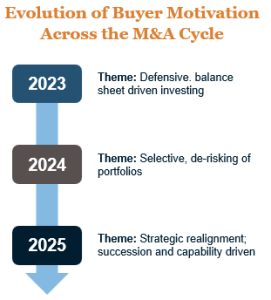
1.Strategic Repositioning and Portfolio Optimization: Strategics increasingly used M&A to reshape portfolios rather than pursue purely cyclical growth. Divestitures of non-core assets and bolt-on acquisitions in higher-growth or more defensible segments became central themes.
2.Technology and Capability Gaps: Digital transformation, automation, data analytics, and AI adoption accelerated acquisition-driven capability building.
3.Succession Dynamics and Sponsor Exit Readiness: Founder and family-owned businesses re-engaged with the market as valuation expectations reset and confidence improved.
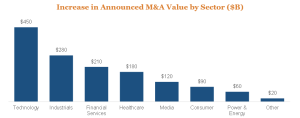
Polarization in Sector Focus
M&A activity in 2025 concentrated in sectors offering resilience, fragmentation, and technology-enabled value creation, with buyers favoring subsectors that supported scalable growth and downside protection.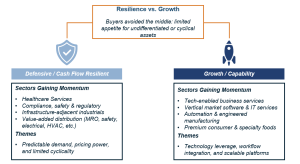
Who Drove M&A in 2025
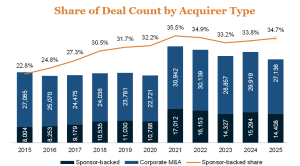
Large-cap strategic acquirers and established private equity platforms dominated competitive processes, prioritizing high-quality assets with durable cash flows, defensible positioning, and clear value-creation pathways. Alternative capital providers such as family offices, minority investors, and permanent capital vehicles played an increasingly important role by offering flexible structures and liquidity solutions where traditional control transactions were less viable.
Together, these buyer groups reinforced a market dynamic in which selectivity, creativity, and certainty of execution outweighed volume-driven approaches, setting a constructive but competitive backdrop heading into 2026.

Tailwinds in Place for Strong Deal Activity in 2026
As we enter 2026, global M&A is underpinned by a rare convergence of relatively stable financial conditions and strategic imperatives driving buyer behavior. With valuation multiples near historic highs and borrowing costs broadly stable, deal value is poised to remain elevated as growing corporate ambition, private capital dry powder, accelerating innovation, particularly in AI, and a supportive financing environment intersect.
- Strategic ambition among large corporates is rising, as megadeals return in scale-dependent sectors following several years of CEO caution driven by high financing costs and regulatory uncertainty.
- Private equity monetization and deployment pressures are intensifying, with extended holding periods, narrowing valuation gaps, and roughly $2 trillion of dry powder driving exits, recapitalizations, continuation vehicles, and structured transactions.
- The race to acquire AI capabilities is accelerating consolidation, extending beyond technology into sectors such as healthcare and services as companies seek scale and capability through inorganic growth.
- M&A financing conditions remain supportive, underpinned by ample private capital, strong lender appetite, and increasing flexibility across public and private credit markets.
As we move into 2026, global M&A activity reflects conditions shaped by available capital, evolving financing costs, and continued interest in technological innovation including artificial intelligence and related sectors. Although economic and policy uncertainty persist, the pace of dealmaking in 2025 demonstrates that buyers are active even amid periods of volatility.
Closing thoughts
The M&A market in 2025 marked a decisive inflection point. After an extended period of muted activity, dealmaking rebounded as financing conditions stabilized, valuation gaps narrowed, and strategic confidence returned. While activity was not uniform across sectors or asset quality, competition intensified for high-quality businesses with durable fundamentals and clear strategic relevance. The result was a more functional, but selective, M&A environment, marked by widening outcome dispersion and increased emphasis on execution certainty.
Heading into 2026, global M&A activity will be supported by relatively stable borrowing costs, elevated levels of private capital, continued innovation and renewed strategic engagement by corporate buyers. At the same time, geopolitical considerations, regulatory scrutiny in sensitive areas, and ongoing market volatility will continue to influence timing, structure, and buyer behavior. Market observations suggest that transaction outcomes in this environment will vary but can favor well-prepared sellers, differentiated assets, and processes that create conviction among a targeted buyer universe rather than broad, undifferentiated outreach.
In this context, the importance of experienced sell-side advice has increased materially. As buyers grow more selective and transaction outcomes diverge, value is increasingly driven by thoughtful positioning, rigorous preparation, and disciplined process management. A skilled advisor can help navigate complexity, manage competitive tension, and align strategic rationale with market realities ultimately influencing not only valuation, but structure and certainty of close. In a market where precision matters more than momentum, effective sell-side execution can be a decisive advantage.
Download a copy of this report here: 2025 M&A Year in Review
Related Articles

March 4, 2026
A New Chapter of Success and Growth

January 28, 2026
Is Passive Ownership Right for You?

April 7, 2025